Get Ahead of Yourself
What You Fight Through Today May One Day Fight for You
Most of us have been told at some point, “Don’t get ahead of yourself.” Usually, that is wise advice. But when it comes to our spiritual lives, there are times when we need to do exactly the opposite—not by rushing God’s timing, but by building something today that will be waiting for us tomorrow.
David’s story shows us what that kind of preparation looks like.
There is a place in Israel called the Valley of Elah. Today, tourists visit the valley where David fought Goliath. They walk down toward the stream, and many of them pick up a smooth stone as a souvenir.
You can imagine it, can’t you?
You kneel down, find a stone that feels about the right size, put it in your pocket, and take it home. Maybe you put it on a shelf. Maybe you show it to your friends and say, “This came from the valley where David defeated Goliath.”
One guide admitted that there are so many tourists taking stones that they have to bring more rocks into the valley. So, in all likelihood, the stone in your pocket was never anywhere near David.
But that really isn’t the point.
The rock is not valuable because it came from the Valley of Elah. It is valuable because
- · it reminds us what happened there.
- · It reminds us that a shepherd boy stood before a giant.
- · It reminds us that faith ran toward fear.
- · It reminds us that God can take something ordinary—a smooth stone from a stream—and use it to accomplish something extraordinary.
But there is something else about that stone.
Before David could throw it, he had to pick it up.
Before he could stand before Goliath, he had to kneel beside the stream.
That is where this story begins. Not with David standing over a giant. Not with David holding a sword.
It begins with David on his knees, choosing stones.
Two Scenes, One Thread
Consider two moments from David’s life.
The first is probably the most famous moment of his life. David faces Goliath in the Valley of Elah.
The second happens years later. It is quieter, messier and far less celebrated. David is running for his life, and he finds himself asking a priest for help.
At first, these stories may not seem connected, but there is a thread running through both of them. Something David did in one season was waiting for him in another.
A victory from his past became provision for his future. A weapon he once defeated was waiting to fight for him.
And that brings us to our big idea:
The foundations you lay today become the weapons waiting for you tomorrow.
Or we could say it this way:
What you fight through today may one day fight for you.
The Stone
Israel’s army is gathered on one side of the Valley of Elah. The Philistines are gathered on the other. Every day, Goliath walks into the valley and challenges Israel. He is loud. He is intimidating. He is experienced. He is armed. He is everything David is not.
And everyone is afraid.
Then David arrives. David has not come to fight. He has come to deliver food to his brothers and check on their welfare. But while he is there, he hears Goliath defying Israel and dishonouring God.
Something rises inside David.
David looks around and essentially asks, “Is nobody going to do anything about this?”
His oldest brother becomes angry with him. Saul doubts him. Goliath laughs at him.
But David remembers what God has already done.
- · He remembers the lion.
- · He remembers the bear
- · He remembers the private victories that prepared him for this public battle.
1 Samuel 17:40 (CSB)
“Instead, he took his staff in his hand and chose five smooth stones from the wadi and put them in the pouch, in his shepherd’s bag. Then, with his sling in his hand, he approached the Philistine.”
David went down to the stream and chose five smooth stones. And to pick up those stones, David had no choice but to kneel.
- · Before David rose like a lion, he knelt like a lamb.
- · Before he ran toward the giant, he got low before God.
- · Before there was public victory, there was private surrender.
If we are honest, we often want the standing-over-the-giant moment without the kneeling-beside-the-stream moment.
- · We want authority without surrender.
- · We want victory without preparation
- · We want the platform without the pasture.
- · We want God to do something through us, but we resist what God wants to do in us.
In other words, we often want all the glory without any of the guts.
David picked up five stones, He would only need one.
Perhaps he simply wanted to be prepared. But either way, he spent more time gathering stones than the victory ultimately required.
There is something in that for us.
- · You may spend more time praying than the immediate situation seems to require.
- · You may spend more time studying Scripture than seems necessary for today.
- · You may spend more time worshipping, serving, giving and preparing than anyone recognizes.
But time spent on your knees is never wasted. You do not know which prayer will steady you. You do not know which verse will return to you. You do not know which act of obedience will prepare you for an opportunity you cannot yet see.
David walked into the valley with five stones, but one was enough.
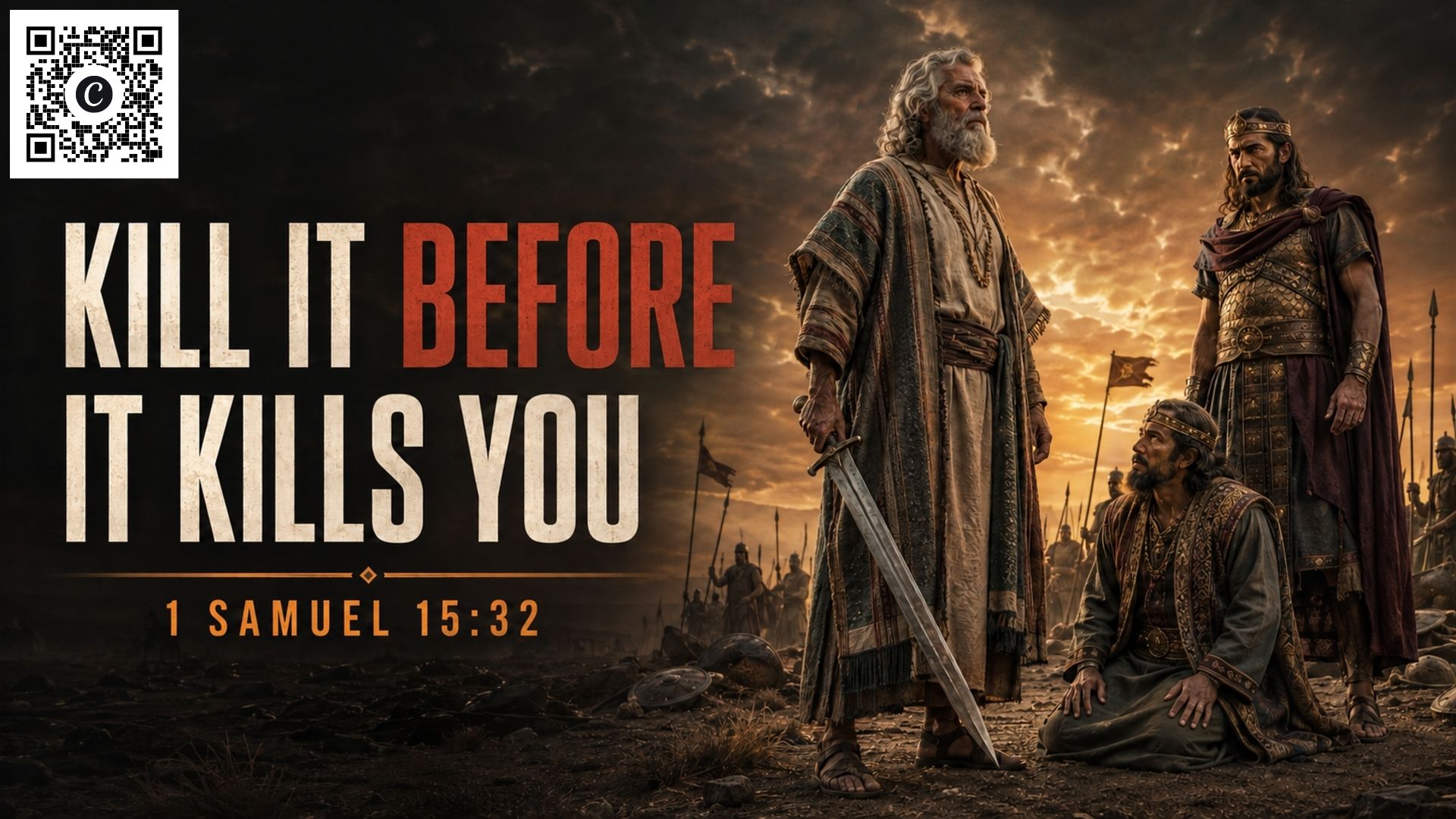
He ran toward Goliath. He placed the stone in his sling. The stone struck Goliath in the forehead, and the giant fell facedown. David then took Goliath’s own sword and used it to finish the battle.
The weapon that had been intended to kill David became the weapon David used to complete the victory.
Remember that sword. We are going to see it again.
The Sword
Years have passed. David is no longer standing before Goliath. Now he is running from Saul. He has been celebrated, promoted and welcomed into the king’s household. But Saul has become jealous and unstable.
David has gone from national hero to hunted fugitive. He leaves with almost nothing.
No army. No supplies. No food. No weapon.
He is afraid, under pressure and trying to survive.
This is not David at his best. He is frightened, and he is not completely honest with Ahimelech about why he is there. Scripture does not hide the weaknesses of its heroes.
But where does David go when he has nowhere else to go?
He goes to Nob. He goes to the sanctuary. He goes to the house of God.
David asks Ahimelech the priest for food. The priest gives him consecrated bread.
Then David asks for a weapon.
1 Samuel 21:8–9 (CSB)
David said to Ahimelech, “Do you have a spear or sword on hand? I didn’t even bring my sword or my weapons since the king’s mission was urgent.”
9 The priest replied, “The sword of Goliath the Philistine, whom you killed in the Valley of Elah, is here, wrapped in a cloth behind the ephod. If you want to take it for yourself, then take it, for there isn’t another one here.”
“There’s none like it!” David said. “Give it to me.
Can you imagine that moment?
David walks into the sanctuary empty-handed. He is tired. He is hungry. He is afraid. He is running for his life.
Then the priest reaches behind the ephod and brings out a sword. Not just any sword. Goliath’s sword.
The sword from the most famous victory of David’s life had been waiting for him in the house of God.
David got the head of Goliath—but in doing so, he also got ahead of himself.
What he conquered in one season became provision in another.
The victory he won years earlier had gone ahead of him.
David did not know, when he faced Goliath, that he was preparing a weapon for one of the lowest moments of his life. But God knew.
We do not know what today’s obedience is preparing for tomorrow.
- · You do not know when the prayer you pray today will become the strength you need tomorrow.
- · You do not know when the Scripture you put into your heart today will become the weapon you reach for tomorrow.
- · You do not know how the generosity you practise today will open the door for ministry tomorrow.
- · You do not know how the faithfulness nobody sees today will prepare you for the battle everybody sees tomorrow.
Too many people are simply getting by:
- · Spiritually, they are getting by.
- · Financially, they are getting by.
- · Relationally, they are getting by
- · Emotionally and physically, they are getting by.
Everything is hand to mouth. Everything is crisis management. Everything is about surviving until tomorrow.
I understand that there are seasons when survival feels like all we can manage.
But God does not want survival to become the permanent condition of your soul.
God wants to build something in you today that will be waiting for you tomorrow. He wants you to get ahead of yourself.
How Do We Get Ahead?
Plant Yourself Spiritually
When David had nothing, he went to the house of God. And what did he find there?
- · Bread for his stomach and a blade for his hand.
- · Provision for the journey and protection for the fight.
That is a picture of what the church is supposed to be.
The church is not merely a building we visit once a week. The church is a sanctuary where weary people encounter the presence of God. It is a table where hungry people are fed. It is an armoury where believers are equipped. It is a family where wounded people discover that they do not have to fight alone.
David later wrote in Psalm 27:4 (CSB):
I have asked one thing from the Lord; it is what I desire: to dwell in the house of the Lord all the days of my life, gazing on the beauty of the Lord and seeking him in his temple.
David was not merely committed to a location. He was committed to the presence of God.
Psalm 84:10 (CSB) says:
Better a day in your courts than a thousand anywhere else. I would rather stand at the threshold of the house of my God than live in the tents of wicked people.
If you want to get ahead spiritually, plant yourself in the presence of God.
- · Plant yourself in Scripture.
- · Plant yourself in prayer.
- · Plant yourself in worship.
- · Plant yourself in the church.
Roots do not grow because a tree visits the soil occasionally. Roots grow because the tree remains planted.
- · You cannot build spiritual strength on occasional contact with God.
- · You cannot spend six days allowing the world to shape your thinking and expect one hour on Sunday to undo all of it
- · You need more than a weekly visit. You need daily roots.
Psalm 23 says that God prepares a table before us in the presence of our enemies.
We have everything we need in the presence of God. Enemy might be present, but he’s already been defeated.
David found bread and a sword in the sanctuary.
You may walk into the presence of God empty-handed, but you do not have to leave empty-hearted.
Plant yourself spiritually. What you store in your spirit today will be available when the battle comes tomorrow.
Honour Authority
David’s relationship with Saul was complicated.
Saul had welcomed David into the palace, but Saul also tried to kill him.
Saul was still the king, but he was no longer acting like the man God had called him to be.
David refused to kill Saul when he had the opportunity. Twice he could have ended Saul’s life, and twice he refused. David understood that Saul’s failure did not give David permission to abandon his own character.
That is important.
- · You do not have to become dishonourable because somebody else has behaved dishonourably.
- · You do not have to become cruel because somebody has treated you cruelly.
- · You do not have to lose your integrity because someone else has lost theirs.
But honour does not mean pretending everything is fine.
- · David honoured Saul—and David ran from Saul.
- · He respected Saul’s position—but he did not stay within reach of Saul’s spear.
Honour is not blind obedience. It is not permission for abuse. It is not refusing healthy boundaries.
David would not attack Saul, but neither would he remain in a room where Saul kept trying to pin him to the wall.
Romans 13:1 CSB teaches us:
Let everyone submit to the governing authorities, since there is no authority except from God, and the authorities that exist are instituted by God.
Paul wrote those words under the Roman Empire. This was not comfortable theology. It was conviction.
Authority can be one of the tools God uses to shape, test and train us.
That does not mean every decision made by a leader is right. When human authority commands what God forbids, or forbids what God commands, our first loyalty remains with God.
But how we respond still matters.
David would not seize through rebellion what God had promised to give him in God’s timing. David had already been anointed as the future king, but he refused to manufacture the fulfilment of the promise.
He trusted God enough to wait. David got ahead by remaining faithful.
Do not sacrifice your character to accelerate your calling.
If God has promised it, you do not have to manipulate it.
Honour God. Honour people. Let God handle the timing.
Worship Continually
- · Before David was a warrior, he was a worshipper.
- · Before he ever walked into a palace, he worshipped in a pasture.
- · Before crowds sang songs about him, David sang songs to God when nobody was listening.
The years with the sheep looked insignificant. But they were not wasted years.
- · In the pasture, David learned to worship.
- · In the pasture, he learned to protect what had been placed in his care.
- · In the pasture, he fought the lion and the bear.
- · In the pasture, he learned that God was faithful.
The wilderness was not empty space between David and his destiny.
The wilderness was training.
Some of us are waiting for a more important season before we become faithful.
- · “When I have more time, I will pray.”
- · “When life settles down, I will worship.”
- · “When I have more money, I will give.”
- · “When somebody notices me, I will serve.”
But if you will not worship in the pasture, you will not be prepared for the palace.
David’s worship went ahead of him.
Long before Saul knew David as a warrior, he knew him as a worshipper. When Saul was tormented, someone remembered that David could play the lyre.
What David developed in private opened a door in public.
Worship is the sound of a healthy soul.
Worship reminds us that the giant is not the biggest thing in the valley.
Worship puts fear back into perspective.
Worship turns our attention away from the size of the enemy and toward the greatness of God.
When you worship, you are getting ahead of yourself.
- · You are putting truth into your soul before the lie arrives.
- · You are remembering God’s faithfulness before fear asks you to forget.
- · You are building an altar today that you may need to return to tomorrow.
Do not wait until the battle begins to learn how to worship. Worship continually.
Give Stubbornly
Why was Goliath’s sword at the sanctuary?
The text does not tell us every detail. 1 Samuel 17 tells us that David initially placed Goliath’s armour in his own tent. But by the time we reach 1 Samuel 21, the sword is at Nob, wrapped in cloth and kept behind the ephod.
It appears that this trophy of victory had been dedicated to God.
- · David could have kept it as a trophy.
- · He could have hung it on his wall.
- · He could have displayed it and told everyone, “That sword belonged to the giant I defeated.”
Instead, the sword was in the house of God.
David seems to have recognized that the victory did not ultimately belong to him. It belonged to God. And because it had been placed in God’s hands, it was waiting when David needed it again.
Years later, David said in 2 Samuel 24:24 CSB:
“…I will not offer to the Lord my God burnt offerings that cost me nothing.”
- · David understood that worship and generosity cost something.
- · Real generosity is not giving God whatever happens to be left over.
- · It is choosing to put something valuable into His hands.
Generosity prepares us.
- · It loosens the grip of possessions on our hearts.
- · It teaches us to trust God as our provider.
- · It creates resources for ministry.
It allows today’s blessing to become tomorrow’s provision—for us, for the church and for people we may never meet.
When God places something in your hands, it is for more than your consumption.
- · It may be seed.
- · It may be a sword
- · It may be something God wants to use again.
This is true of money, but it is also true of your time, your abilities, your testimony and your opportunities.
What are you holding as a trophy that God is asking you to place in His hands?
What could God do through our generosity if we give Him what costs us something?
- · Give stubbornly.
- · Give when it is easy.
- · Give when it requires faith.
- · Give when nobody applauds.
- · Give because God has been faithful.
What we place in God’s hands is never wasted.
What You Fight Through May Fight for You
David walked into the Valley of Elah with a sling.
Years later, he walked out of the sanctuary with Goliath’s sword.
What he once fought against was now fighting for him.
That is what God can do with your battles.
- · The pain you survive can become compassion for someone else.
- · The failure God restores can become wisdom that protects you in the future.
- · The season that taught you to pray can become the reason you know how to stand when another crisis comes.
- · The Scripture that carried you through grief can become the word you offer to another grieving person.
- · The financial discipline you establish today can create opportunities for generosity tomorrow.
The faith you develop in one valley may be the weapon you reach for in the next.
Do not waste your battle. Our prayer must become more than, “God, get me out of this.”
You may be gathering stones right now.
You may feel as though all you are doing is kneeling beside a stream while everyone else is watching the giant.
Keep gathering. Keep praying. Keep worshipping. Keep serving. Keep giving. Keep obeying.
You are not wasting time. You are getting ahead of yourself.
The Greater David
There is one more thread running through this story.
1 Samuel 17:54 says:
David took Goliath’s head and brought it to Jerusalem…
That is a strange detail because Jerusalem had not yet become David’s capital. At that time, it was still controlled by the Jebusites.
David carried the evidence of his victory toward Jerusalem.
Years later, another Son of David would go to Jerusalem. Jesus is the greater David.
David entered a valley to face an enemy Israel could not defeat.
Jesus entered Jerusalem to face an enemy humanity could not defeat.
David defeated Goliath using Goliath’s own weapon.
Jesus defeated death through death itself.
Hebrews 2:14 (CSB) says:
Now since the children have flesh and blood in common, Jesus also shared in these, so that through his death he might destroy the one holding the power of death—that is, the devil—
At the cross, it looked like death had won. It looked like hell had won.
It looked like the enemy’s greatest weapon had finally defeated the Son of God.
But three days later, the stone was rolled away.
The weapon the enemy used against Jesus became the means through which Jesus defeated the enemy.
Through death, Jesus defeated death.
Through the cross, Jesus disarmed the powers of darkness.
Through the grave, Jesus opened the way to resurrection life.
The enemy’s greatest weapon became the instrument of his own defeat.
And because Jesus went ahead of us, we do not face death alone.
He went ahead of us into suffering.
He went ahead of us into the grave.
He went ahead of us in resurrection.
He has already entered the place we fear most, defeated the enemy and made a way for us to follow.
· You may feel like you are facing a giant today.
· You may feel like you are running for your life.
· You may have arrived with empty hands, a hungry soul and no idea what to do next.
Come into the presence of God. There is bread for your journey. There is strength for your battle. There is grace for your failure. There is salvation through Jesus.
And perhaps there is a weapon waiting for you—a promise, a testimony, a prayer, a truth God planted in you years ago.
The foundations you lay today become the weapons waiting for you tomorrow.
What you fight through today may one day fight for you.
- · So kneel beside the stream.
- · Gather the stones.
- · Plant yourself spiritually.
- · Honour faithfully.
- · Worship continually.
- · Give stubbornly.
Do more than get by.
By the grace of God, get ahead of yourself.
Watch or Listen to this Sermon Here
Get Ahead of Yourself
In Get Ahead of Yourself, Pastor Gary Adduono connects two moments from David’s life: the day he defeated Goliath with a stone and the day, years later, when Goliath’s sword was waiting for him in the house of God.
David could not have known that the victory he won in one season would become provision for another. Through his story, this message explores how today’s prayers, obedience, worship, generosity and faithfulness prepare believers for tomorrow’s battles. What is developed in private may one day provide strength in public.
The message also points to Jesus, the greater David, who defeated death through death itself. Because Christ has gone ahead, no believer faces the battle alone.
The foundations laid today become the weapons waiting tomorrow. What someone fights through today may one day fight for them.
1 Samuel 17:40–54
1 Samuel 21:8–9
Psalm 23
Psalm 27:4
Psalm 84:10
Romans 13:1
2 Samuel 24:24
Hebrews 2:14
Faith, Preparation, Worship, Generosity, Victory